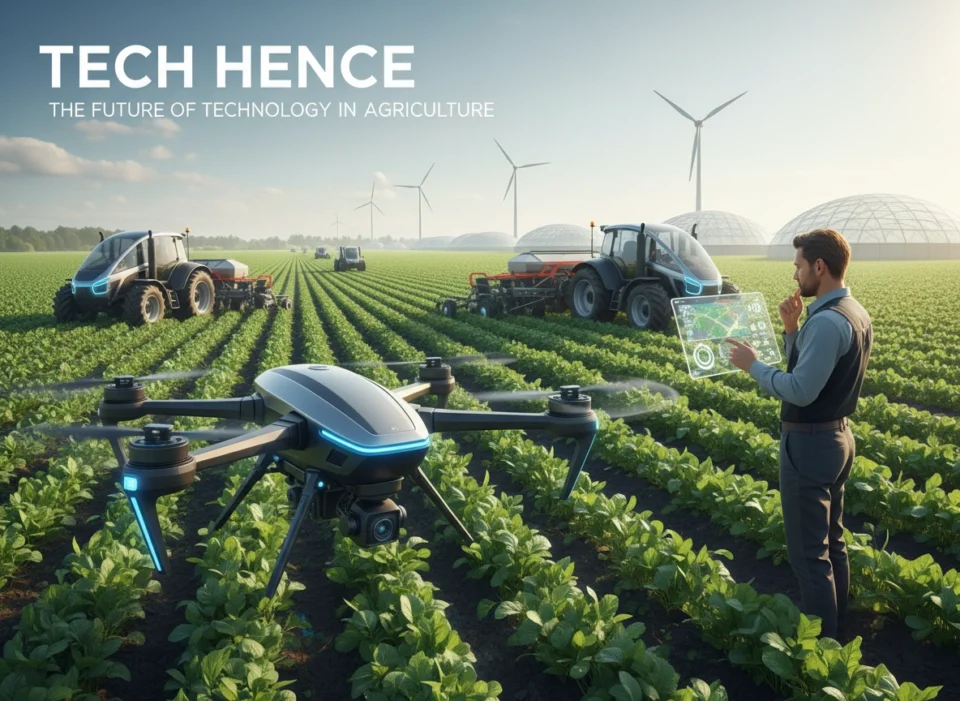
The image of the traditional farmer—waking up at dawn to manually till the soil and guessing the weather by the look of the sky—is rapidly fading into history. Today, a farmer is just as likely to be piloting a drone or analyzing soil data on a tablet as they are to be driving a tractor. We stand on the brink of a massive shift in how we grow, harvest, and distribute food. This movement is often referred to as “AgTech” or smart farming, but it represents something deeper: a fundamental rethinking of agriculture powered by innovation. Tech hence becomes not just a tool, but the very foundation of modern food security.
This article explores how technology is revolutionizing agriculture. We will examine advancements like Artificial Intelligence (AI), the Internet of Things (IoT), drones, and precision farming, while also addressing the significant benefits and hurdles that lie ahead.
The Digital Harvest: Why Technology Matters Now
The global population is projected to reach nearly 10 billion by 2050. Feeding this many people will require a 70% increase in food production. However, arable land is shrinking due to urbanization and climate change, and fresh water is becoming a scarce commodity. The old ways of farming simply cannot scale to meet this demand without destroying the planet.
This is where technology steps in. It offers the promise of “more with less”—more yield with less water, fewer chemicals, and reduced labor. By integrating advanced systems into everyday farming practices, we can transform agriculture from a labor-intensive industry into a data-driven science.
Precision Farming: The Cornerstone of Modern AgTech
Precision farming, or precision agriculture, is the practice of managing variations in the field to maximize yield and minimize waste. It moves away from the “spray and pray” method—where an entire field is treated equally—to a hyper-localized approach.
Variable Rate Technology (VRT)
One of the most impactful tools in precision farming is Variable Rate Technology. VRT allows farmers to apply inputs such as fertilizer, water, and pesticides at different rates across a field. Using GPS mapping and soil sensors, machinery can automatically adjust the flow of these inputs. If one corner of a field is rich in nitrogen, the sprayer slows down. If another patch is nutrient-deficient, it speeds up. This ensures that crops get exactly what they need, reducing chemical runoff and lowering costs for the farmer.
Automated Guidance Systems
GPS-guided tractors are no longer futuristic; they are standard on many large farms. These systems steer machinery with incredible accuracy, reducing overlaps and missed spots during planting and harvesting. This might seem minor, but reducing overlap by just 10% on a thousand-acre farm saves significant amounts of fuel, seed, and time.
The Eyes in the Sky: Drones and Satellite Imaging
Aerial technology has given farmers a new perspective on their crops—literally. Drones and satellites provide critical data that is invisible to the naked eye.
Crop Monitoring and Health Assessment
Drones equipped with multispectral cameras can capture images that show plant health by measuring light absorption. Healthy plants reflect light differently than stressed ones. Farmers can spot irrigation leaks, pest infestations, or nutrient deficiencies weeks before they would be visible on the ground. This early detection allows for rapid intervention, saving crops that might otherwise be lost.
Automated Planting
Beyond monitoring, drones are taking active roles in planting. Startups are developing heavy-lift drones capable of shooting seed pods into the soil at high speeds. These systems are particularly useful for reforestation efforts or planting cover crops in difficult terrain where tractors cannot go.
The Brain of the Operation: Artificial Intelligence and Machine Learning
If sensors and drones are the eyes and hands of modern farming, Artificial Intelligence (AI) is the brain. The sheer volume of data generated by modern farms is overwhelming for a human to process. AI systems ingest this data to find patterns and make predictions.
Predictive Analytics
AI algorithms analyze historical weather data, crop performance, and market trends to help farmers make better decisions. For example, an AI system might predict a fungal outbreak based on humidity levels and temperature, advising the farmer to apply fungicide only when and where necessary. This predictive capability shifts farming from reactive to proactive.
Robotic Labor
Labor shortages are a chronic issue in agriculture. AI-driven robots are stepping in to fill the gap. We are seeing the rise of autonomous fruit pickers that use computer vision to identify ripe produce and robotic arms to pluck it gently without bruising. Weeding robots can distinguish between crops and weeds, zapping the unwanted plants with lasers or small doses of herbicide, drastically reducing chemical usage.
The Connected Farm: IoT and Smart Sensors
The Internet of Things (IoT) refers to the network of physical devices embedded with sensors and software that connect and exchange data. In agriculture, IoT is creating a nervous system for the farm.
Smart Irrigation
Water scarcity is perhaps the most pressing challenge in agriculture. Traditional irrigation systems are often inefficient, watering crops regardless of soil moisture levels. IoT sensors placed in the soil measure moisture in real-time. These sensors communicate with the irrigation system, turning water on only when the soil is dry and shutting it off the moment optimal moisture is reached. This can reduce water usage by up to 30-50%.
Livestock Monitoring
IoT isn’t just for plants. “Smart collars” and ear tags for livestock monitor the health and location of animals. These devices track movement, temperature, and feeding habits. If a cow is eating less or moving strangely, the system alerts the farmer to potential illness. This individual animal management improves herd health and ensures higher quality dairy and meat products.
Challenges to Adoption
Despite the undeniable benefits, the path to a high-tech agricultural future is not without obstacles.
High Initial Costs
The most significant barrier is cost. Drones, smart tractors, and sensor networks require substantial upfront investment. Smallholder farmers, who produce a significant portion of the world’s food, often cannot afford these technologies. This threatens to create a “digital divide” where only large corporate farms can thrive.
Connectivity Issues
Smart farming relies heavily on internet connectivity to transmit data from the field to the cloud. However, rural areas—precisely where farms are located—often have the poorest internet infrastructure. Without reliable 5G or high-speed broadband, the potential of IoT and real-time analytics remains unlocked.
Data Privacy and Ownership
As farms generate terabytes of data, questions arise about who owns that information. Is it the farmer, or the company that built the tractor and the software? Farmers worry that their data could be sold to commodity traders or used to manipulate market prices. Clear regulations and data sovereignty laws are needed to build trust.
The Future Potential: Beyond the Horizon
Looking ahead, the integration of these technologies suggests a future where farming is nearly autonomous and incredibly sustainable.
We may see the rise of Vertical Farming in urban centers, where crops are grown in stacked layers under LED lights, completely controlled by AI. This would drastically reduce the transportation carbon footprint of food.
Gene Editing (CRISPR) technology, combined with data analytics, will allow us to design crops that are resistant to drought, pests, and disease, customized for specific soil types.
Furthermore, Blockchain technology will likely become standard for supply chain transparency. Consumers will be able to scan a QR code on an apple and see exactly which farm it came from, when it was picked, and what inputs were used to grow it.
Conclusion
Tech hence represents the bridge between our current limitations and a sustainable future. The convergence of AI, IoT, and robotics in agriculture is not merely a trend; it is a necessary evolution. While challenges like cost and connectivity remain, the momentum is undeniable.
By embracing these innovations, we can ensure that agriculture remains a viable profession for the next generation while securing a stable food supply for a growing world. The farm of the future will be a place where technology and nature work in harmony, guided by data, driven by efficiency, and rooted in sustainability.