
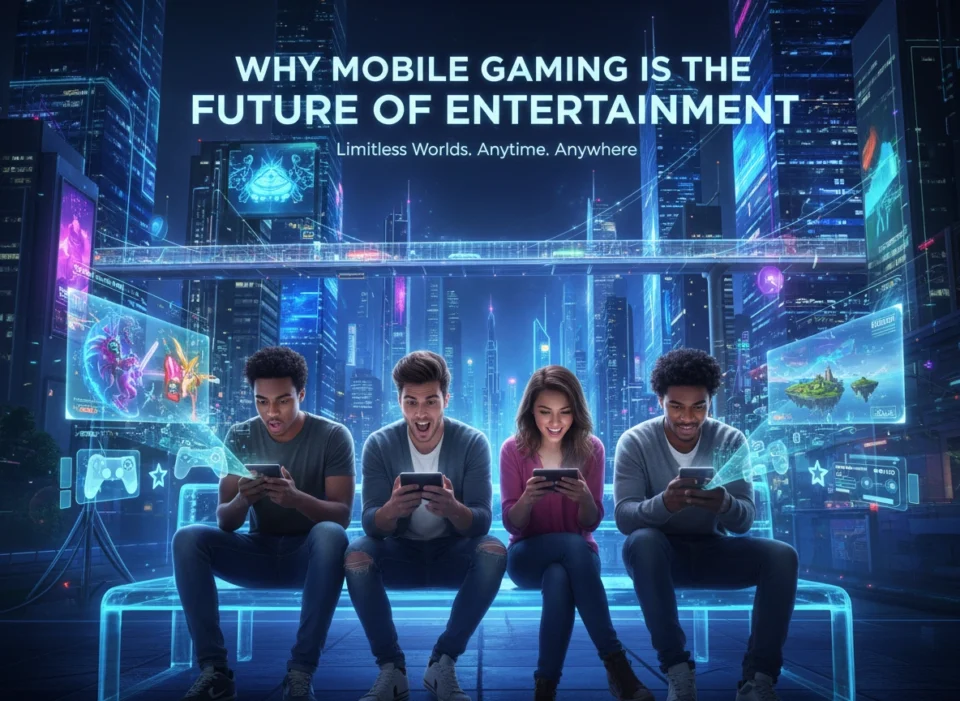
There was a time when playing video games meant sitting in front of a heavy CRT television or huddling over a desktop computer in a dark room. Gaming was a destination—a specific activity you set aside time to do. That dynamic has fundamentally shifted. Today, the most popular gaming console isn’t a box under your TV; it’s the sleek rectangle of glass and metal already in your pocket.
Mobile gaming has quietly transformed from a casual distraction—think Snake on a Nokia brick—into the dominant force in the global entertainment industry. It now generates more revenue than the film and music industries combined. This isn’t just a trend; it’s a paradigm shift. With advancements in hardware, cloud computing, and connectivity, mobile gaming is poised to define the future of how we consume entertainment.
This article explores how we got here, the technologies accelerating this growth, and why the future of entertainment is undeniably mobile.
The Evolution: From Snake to console-Quality Experiences
The journey of mobile gaming is a masterclass in rapid technological evolution. In the late 1990s, mobile games were simplistic, pixelated, and pre-installed. They were novelties, not serious entertainment. The launch of the App Store in 2008 changed everything. Suddenly, developers had a direct line to consumers. Games like Angry Birds and Candy Crush Saga proved that mobile titles could be cultural phenomena, not just time-killers.
However, the real turning point came when hardware finally caught up with ambition. Modern smartphones now possess processing power that rivals, and in some cases exceeds, previous generations of dedicated gaming consoles. We have moved past tapping candy pieces to playing full-fledged, graphically intensive titles like Genshin Impact or Call of Duty: Mobile. These games offer deep narratives, complex mechanics, and high-fidelity graphics that were unimaginable on a phone just a decade ago.
This evolution has democratized gaming. You no longer need a $500 console or a $2,000 PC to experience high-quality interactive entertainment. You just need the device you use to text your friends.
The Economic Juggernaut: By the Numbers
To understand why mobile gaming is the future, you have to look at the money. The economics of mobile gaming are staggering. According to data from Newzoo, the global games market generated over $180 billion in recent years, with mobile gaming accounting for more than half of that revenue.
This dominance is driven by the “freemium” model. By lowering the barrier to entry to zero, developers can acquire massive user bases. Revenue is then generated through microtransactions, battle passes, and ad placements. While controversial to some traditionalists, this model has proven to be the most effective monetization strategy in entertainment history.
Consider these factors driving the economy:
- Global Reach: There are billions of smartphone users worldwide. Markets in Asia, particularly China and India, have skipped the console generation entirely, jumping straight to mobile as their primary gaming platform.
- Accessibility: Mobile games fit into the “in-between” moments of life. You can play for five minutes on a bus or three hours on a couch. This flexibility increases engagement and retention.
- Low Barrier to Entry: Unlike console gaming, which requires purchasing hardware and $70 software, mobile gaming usually requires no upfront cost beyond the phone you already own.
Technology Driving the Revolution
Several key technological advancements are currently accelerating the mobile gaming industry, pushing it from a “casual” platform to a serious competitor for hardcore gamers.
5G Connectivity
High-speed, low-latency internet is the backbone of modern mobile gaming. 5G allows for multiplayer experiences that are as smooth as a wired connection. It reduces lag, which is critical for competitive games like PUBG Mobile or League of Legends: Wild Rift. As 5G infrastructure expands globally, the gap between home internet and mobile data will vanish, making seamless online play the standard.
Cloud Gaming
Cloud gaming services like Xbox Cloud Gaming (xCloud) and NVIDIA GeForce Now are blurring the lines between platforms. These services allow users to stream high-end console and PC games directly to their phones. The heavy lifting is done by powerful remote servers, meaning your phone essentially acts as a screen and controller. This technology effectively turns a mid-range smartphone into a high-end gaming PC, removing hardware limitations entirely.
Augmented Reality (AR)
Pokémon GO showed the world the potential of AR, but we are only scratching the surface. As mobile cameras and sensors improve, AR will blend the digital and physical worlds more seamlessly. Apple and Google are heavily investing in AR frameworks (ARKit and ARCore), setting the stage for games that use our actual environment as the level design. This creates a form of immersion that traditional screens cannot replicate.
The Social Ecosystem
Entertainment is increasingly social, and mobile gaming has capitalized on this better than any other medium. Mobile games are not just games; they are social platforms.
Titles like Roblox and Fortnite (which has a massive mobile presence) function as virtual hangouts. Teenagers log in not just to shoot enemies, but to attend virtual concerts, watch movie trailers, or simply chat with friends in a 3D space. This concept of the “Metaverse”—a shared virtual space—is being built primarily on mobile foundations because that is where the users are.
Furthermore, the integration with social media is seamless. Sharing a high score, a replay clip, or inviting a friend to a match is instantaneous. This virality creates organic marketing and keeps communities engaged long after a game’s initial release.
Future Trends: What Lies Ahead?
As we look toward the next decade, several trends suggest mobile gaming will continue to absorb other forms of entertainment.
Cross-Platform Play
The walls between platforms are crumbling. We are moving toward a future where “mobile gamer” and “PC gamer” are no longer distinct identities. Cross-platform play allows a mobile user to team up with a console user. This unification expands the player pool and reinforces the idea that the device is secondary to the experience.
The Rise of Mobile Esports
Esports is already a massive industry, but mobile esports is the fastest-growing sector. Tournaments for mobile games like Mobile Legends: Bang Bang fill stadiums in Southeast Asia and draw millions of online viewers. As competitive mobile games become more sophisticated, we will see mobile esports rival traditional sports in viewership and sponsorship revenue.
Subscription Services
Just as Netflix revolutionized TV, subscription services like Apple Arcade and Google Play Pass are changing how we pay for games. These services offer access to hundreds of premium games without ads or microtransactions for a monthly fee. This shifts the focus back to quality gameplay and artistic merit, providing a healthy alternative to the aggressive monetization of free-to-play titles.
Conclusion
Mobile gaming has transcended its origins as a way to pass time while waiting in line. It has evolved into a sophisticated, diverse, and economically dominant force that is reshaping the entertainment landscape. Driven by powerful hardware, 5G connectivity, and a massive global audience, it offers experiences that are accessible, social, and increasingly indistinguishable from high-end console gaming.
The future of entertainment isn’t tethered to a living room wall. It is portable, connected, and constantly evolving. As technology continues to advance, the device in your pocket will likely become your primary portal to virtual worlds, social gatherings, and interactive storytelling. Mobile gaming isn’t just the future; for billions of people, it is already the present.
Please visit website for more info.
